19 May 2026
Think your crisis drills make you ready? Think again!
BIRGER. is pleased to support the Business Continuity & Resiliency Awareness Week, from 18 to 22 May 2026, under the main theme “Think You’re Resilient? Well, Think Again”. Today’s focus is "Think your crisis drills make you ready? Think again!"
In this context and as part of our ongoing commitment to foster Organisational Resiliency, BIRGER. will share actionable daily tips designed to help organisations strengthen their resiliency. The objective is to encourage organisations assess whether their crisis exercises truly reflect real-world pressure, cross-functional coordination, and communication challenges under disruption.
Our tips and recommendations to help organisations strengthen the effectiveness of their crisis drills and improve real-world readiness:
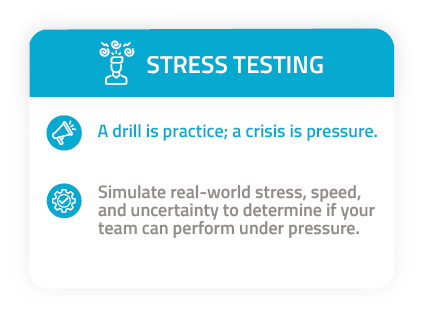 | 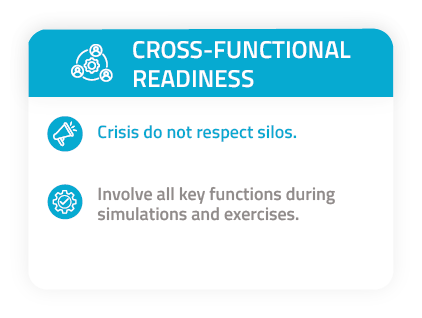 |
A drill tests adherence to procedures, while a real crisis requires effective performance under pressure. To truly assess operational readiness, organisations must go beyond routine exercises and simulate real-world conditions such as stress, time constraints, uncertainty, and disrupted communication. Only through training and such realistic testing can teams demonstrate their ability to respond effectively when it matters most. | Crisis events typically span multiple functions simultaneously and do not conform to organisational silos. Effective preparedness therefore requires cross-functional exercises involving IT, Human Resources, Legal, and Operations to reflect real-world dependencies and practical decision-making. When drills are limited to a single department, the organisation remains untested in coordinated response and is not fully prepared for a real incident. |
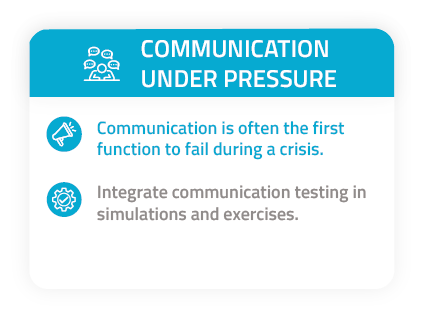 | 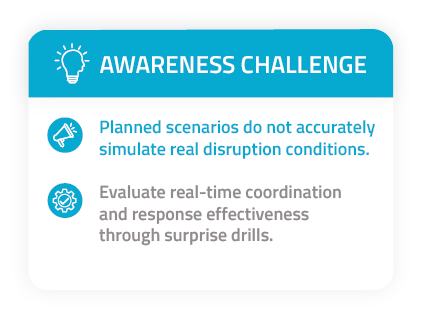 |
Effective preparedness requires rigorous testing of escalation paths, decision-making structures, and stakeholder communication under conditions of pressure and uncertainty. Without structured communication testing embedded in simulations, drills provide only a partial assessment of an organisation’s true response capability. | A “surprise drill” should be conducted without prior notice, predefined scenarios, or rehearsed coordination in order to accurately simulate real disruption conditions. Its objective is to assess how effectively teams identify, prioritise, and respond to unforeseen situations under time pressure and uncertainty. Only unannounced exercises of this nature can provide a true and reliable measure of an organisation’s operational readiness and resiliency. |
Click here to download the tips. Stay tuned and explore our daily tips to strengthen Organisational Resiliency.
For more information on the topic and on our Resiliency Solutions & Services, please contact us by email resiliency@birger.technology.
Regards,
BIRGER.